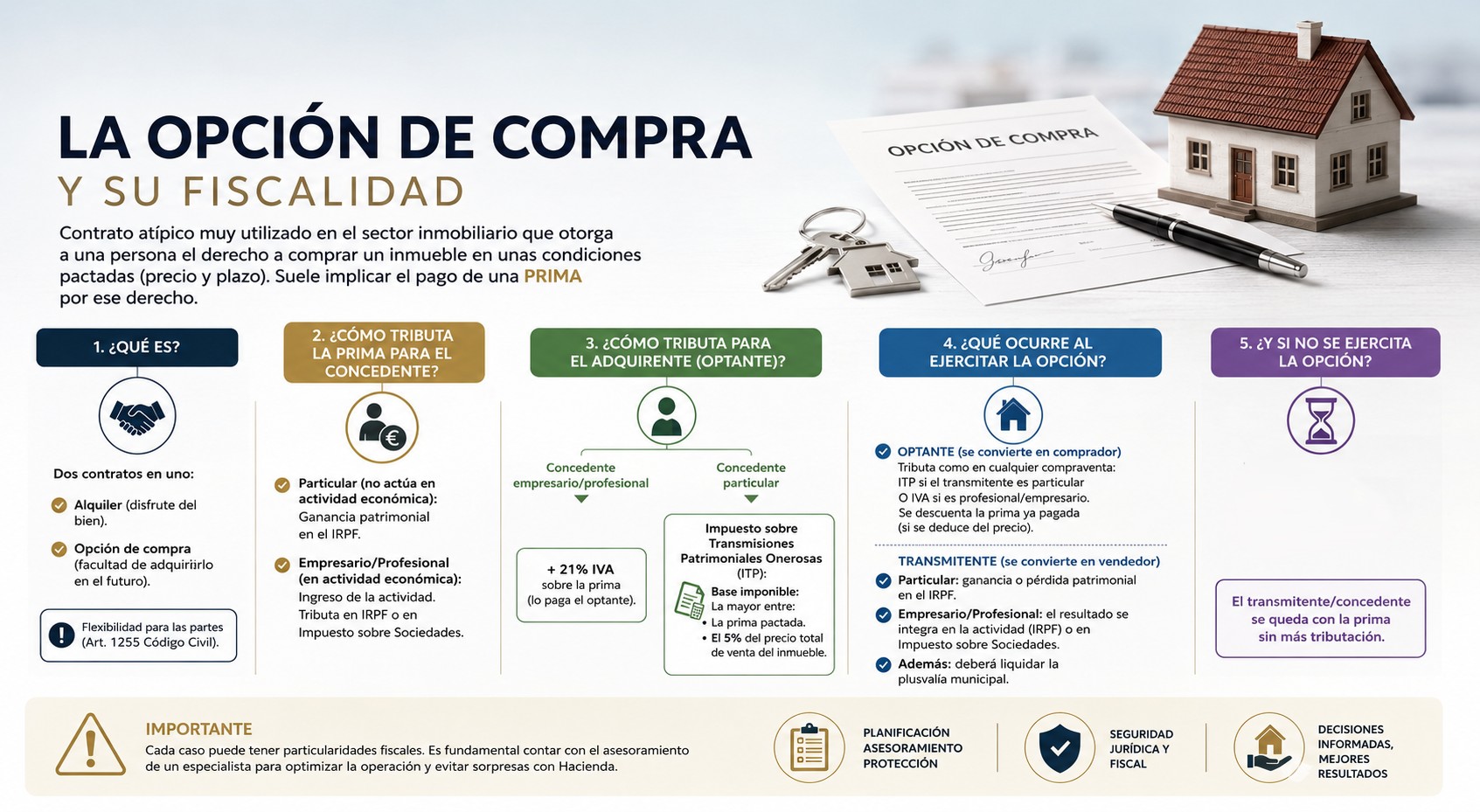
THE PURCHASE OPTION AND ITS TAX IMPLICATIONS:
The purchase option is an increasingly used solution in real estate transactions, but its tax regime is complex, so it is advisable to know in detail the tax obligations that may arise from this type of atypical contract.
I must admit that although I do not usually advise my clients on this type of contract due to the tax complexity it involves and the fact that it may affect several tax years, it can be an interesting option on occasions, although always with the advice and approval of a trusted specialist.
IT IS A GOOD OPPORTUNITY:
-When a buyer has fallen in love with a property but does not have the necessary resources to purchase the property at this time.
-When the owner does not want to lower the price of the property; that is, when they do not need to sell and set the price above market value.
But both parties must assume that they run a significant risk in case the market value fluctuates up or down, since the purchase price in the event the option is exercised within the stipulated period may benefit one or the other, depending on how the market evolves.
It is an operation used mainly in the real estate world but is also permitted for movable assets. It has the advantage of offering flexibility to the parties since, being an atypical contract, it will be subject to what the parties have agreed upon based on the autonomy of the will expressed in Article 1255 of the Civil Code.
It is really two contracts. The lease contract and the subsequent purchase possibility contract.
Through this contract, the owner of a property grants another person the right to acquire it under previously agreed conditions, setting a price and a deadline to exercise that right.
It is usual, although not essential, for the grantor to receive a monetary amount for granting that right. This amount is what is called the PREMIUM of the purchase option.
Next, we will see what tax consequences the granting of the purchase option has and its subsequent active exercise (buying) and passive exercise (letting time pass without buying).
HOW IS THE PREMIUM TAXED?
At the moment the purchase option is granted and the owner receives the corresponding premium, for the grantor, that amount will have different treatment depending on whether or not they act in the exercise of an economic activity:
-Individual grantor and outside any business activity…… the premium constitutes a capital gain that must be included in their Personal Income Tax (IRPF) return.
-Business grantor and within the development of an economic activity…… the premium will be considered income from the activity and will be taxed under Personal Income Tax or Corporate Income Tax, as appropriate.
HOW IS WHAT THE PERSON WHO ACQUIRES THE RIGHT TO THE OPTION TAXED?
Well, it will depend on how the grantor of the option acts, that is, the owner.
-Business or professional grantor….., 21% VAT will be added to the premium, to be paid by the optionee or acquirer.
-Individual grantor……………………….…. the acquirer must be taxed under the Tax on Onerous Transfers of Property. The rate is applied to the tax base which cannot be less than 5% of the agreed purchase price regardless of whether they have agreed on a lower premium or even in the case that they have not agreed on any premium at all.
That is, the tax base will be the highest amount between these two options:
The premium or price stipulated for the purchase option (what you pay only for the right).
5% of the total sale price set for the property
HOW IS IT TAXED WHEN THE OPTION IS EXERCISED?
OPTIONEE: Becomes the buyer. If the optionee decides to exercise their purchase option, they will be taxed when they exercise it, as in any normal sale, but deducting the part of the price advanced with the premium in case it is deducted from the purchase price (since they already paid tax on that amount at the time). That is, they would pay Property Transfer Tax if the seller is an individual or VAT if acting as a professional or business entity.
SELLER: Becomes the vendor.
-If acting as an individual, they may incur a capital gain or loss to be applied in Personal Income Tax.
-If acting in the development of an economic activity, the result of the transaction will be integrated into the income from said activity or in the Corporate Income Tax.
-In addition, the seller must settle the municipal capital gains tax.
BUT WHAT HAPPENS IF THE OPTION IS FINALLY NOT EXERCISED? THAT IS, HOW DOES THE FACT THAT THE DEADLINE EXPIRES AND ONE CHOOSES NOT TO BUY THE PROPERTY AFFECT THE SITUATION?
Not all purchase options are exercised. Let us consider a likely scenario where the purchase option was agreed upon for 300,000 euros, but after 3 years, when the deadline to choose whether to buy it expires, they see that other properties in the same building are on sale for 250,000 euros.
-If no premium was agreed upon for the option, and the optionee decides not to exercise the purchase, it does not generate excessive tax problems.
-But if the optionee paid a premium for the right to buy, the grantor or owner has already paid their taxes at that moment. The optionee who chooses not to buy may claim a capital loss over the next 5 years in Personal Income Tax if acting as an individual, and IF the transaction was linked to an economic activity, it could be considered a deductible expense.
IN SUMMARY AND IN CONCLUSION:
The purchase option is an operation that can be very useful, but it should not be forgotten that it is a so-called atypical contract, since it is not regulated in the legal system, being a doctrinal and case law creation. Only the tax consequences of the transaction are regulated, which as we have seen vary depending on whether a premium is paid or not, whether the parties carry out economic activity or are individuals.
It is a complex transaction with two linked contracts such as a lease contract and a contract where the right to buy the property is granted, leaving the decision to the optionee with the deadline, price and other conditions already set.