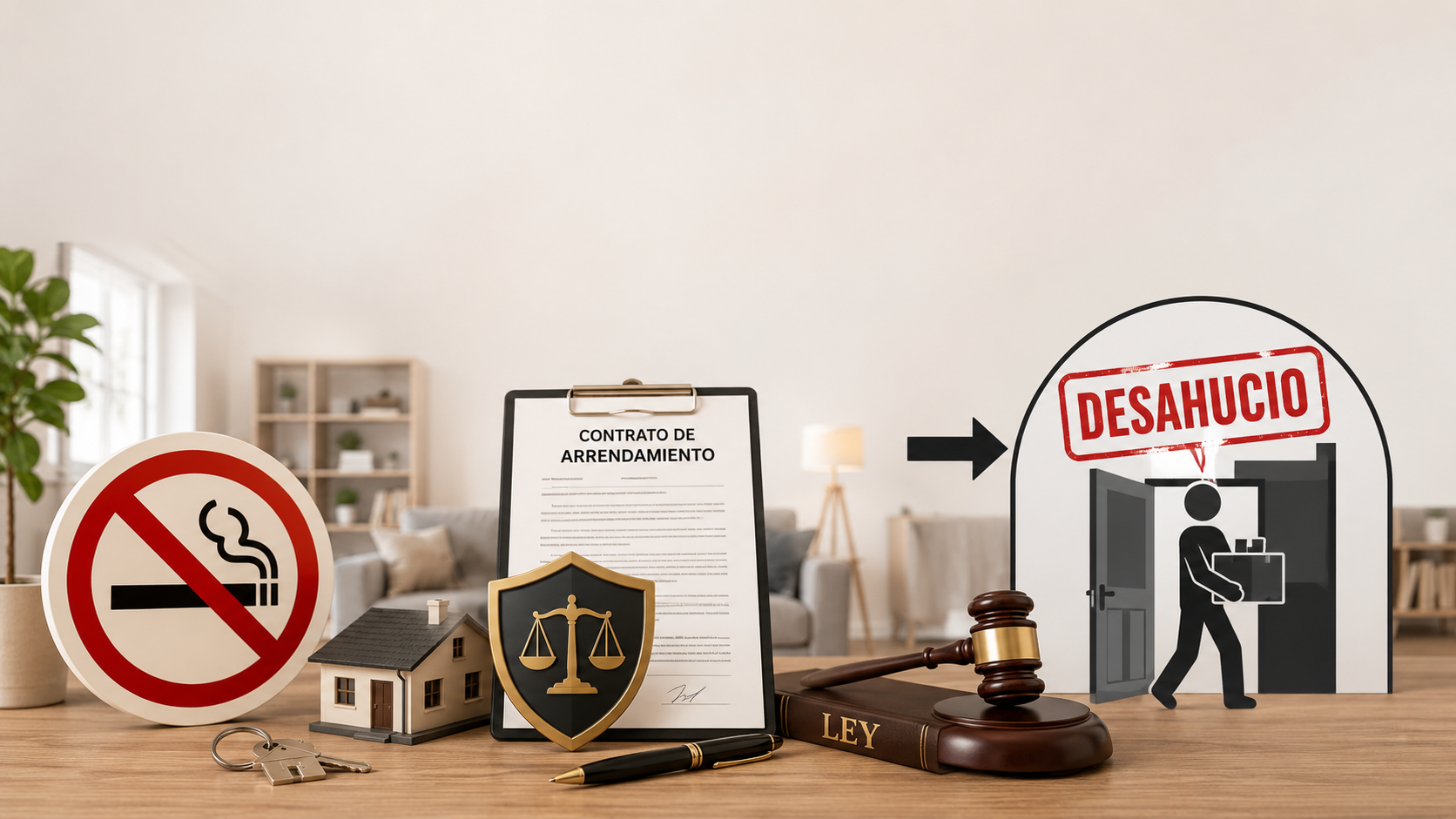
Can smoking be prohibited in a rental property? And can the tenant be evicted if they breach this?
A few years ago this question would have seemed extravagant. Today it no longer is.
More and more property owners are delivering newly renovated homes with new furniture or high-quality finishes, and are concerned about the damage that tobacco smoke can cause to walls, ceilings, textiles, carpentry, or climate control systems.
This raises an interesting legal question:
Can it be agreed in a residential lease contract that the tenant, their family members, or their guests cannot smoke inside the property?
And even more:
Can it be established that the breach of this obligation is grounds for contract termination and eviction?
Freedom of contract as a starting point
Article 1255 of the Civil Code recognizes freedom of contract by establishing that the parties can set the agreements, clauses, and conditions they deem appropriate, as long as they are not contrary to law, morality, or public order.
Therefore, from a strictly contractual perspective, nothing prevents the owner and tenant from agreeing to a clause that prohibits smoking in the property.
The situation would be similar to other clauses commonly accepted by courts, such as those relating to pet ownership, professional use of the property, or certain restrictions on the use of common areas.
There is no rule that recognizes a supposed "right to smoke" within a rented property.
Can the prohibition be extended to family members and guests?
In my opinion, yes.
The tenant is responsible to the landlord for the use of the property by persons occupying the property with their consent.
It would make no sense to prohibit the tenant from smoking while allowing their family members or guests to do so regularly.
Therefore, a reasonably drafted clause should extend the prohibition to all persons who access the property with the tenant's authorization.
Can it also be limited to terraces or gardens?
Here the first difficulty appears.
Prohibiting smoking inside the property appears more legally defensible due to the purpose of protecting the property.
However, when the prohibition extends to terraces, patios, or private gardens, the legal discussion is more complex. In principle, one could also prohibit it or even specify that smoking is only allowed in that area.
Nevertheless, there could be arguments to justify it when:
The intention is to prevent smoke from affecting adjoining properties.
There is a history of neighbor conflicts.
These are terraces integrated into the property itself.
The prohibition has been expressly accepted by the tenant upon signing the contract.
The Urban Leases Law provides support for this thesis
Article 27.1 of the LAU establishes that the breach of obligations resulting from the contract allows for requiring compliance or promoting contract termination in accordance with article 1124 of the Civil Code.
That is, not only are the specific grounds for termination provided in article 27.2 of the LAU relevant.
Contractual breaches that have sufficient legal significance can also justify termination.
Therefore, if the prohibition on smoking is part of the contract and has been expressly accepted by the tenant, it could be argued that its breach constitutes a contractual breach capable of generating a termination action.
The indirect support of the Horizontal Property Law
The Horizontal Property Law does not specifically regulate tobacco either.
However, its article 7.2 allows action against bothersome, unhealthy, harmful, or dangerous activities.
Not all tobacco consumption will necessarily fit these concepts.
But if smoke repeatedly invades adjoining properties and causes proven nuisance, it could strengthen the legal position of the owner and the community.
The real problem: proof
This is the decisive issue.
The validity of the clause is probably easier to defend than proving its breach.
The owner cannot install cameras inside the property or perform controls that violate the privacy of the tenant and their family.
Therefore, proof must be obtained through legitimate means.
Among these could be found:
Explicit admission by the tenant.
Written messages or communications.
Photographs voluntarily provided.
Notarial deeds.
Expert reports proving intense smoke impregnation.
Witness testimony from neighbors.
Repeated complaints from the homeowners' community.
Objective evidence obtained during visits consented to by the tenant.
In practice, the problem will not be drafting a valid clause, but proving its breach with sufficient evidentiary strength.
Would eviction be automatic?
No.
Even admitting the validity of the clause, a court would have to assess:
The severity of the breach.
Its repetition.
The existence of previous warnings.
The damages caused.
The proportionality of contract termination.
It does not seem reasonable to think that a single isolated cigarette smoked on a terrace would by itself justify contract termination.
It would be different if there were repeated, conscious, and persistent breach after having been warned by the owner.
Conclusion
From my perspective, a contractual clause that prohibits smoking in a rental property is legally defensible under the freedom of contract provided by article 1255 of the Civil Code.
I also consider it defensible that the parties agree that its breach constitutes grounds for contract termination.
However, the success of a potential eviction action will depend far less on the wording of the clause than on the landlord's ability to prove serious, repeated, and sufficiently documented non-compliance, all without infringing on the tenant's privacy.
And that is likely where the true legal battle would be fought.
Example of an anti-smoking clause to include in the rental contract:
"The parties expressly agree that the property subject to this contract is rented under the condition that it be maintained as a smoke-free space from tobacco smoke and similar products intended for smoking or vaping.
Consequently, the tenant is obliged not to smoke and not to permit smoking within the property, including all its facilities, rooms, annexed elements, storage units and parking spaces linked to the rental, as well as by any person who accesses the property with the tenant's consent or authorization, whether family members, cohabitants, guests or visitors.
The tenant accepts that on the first day of each month during the rental period, the landlord may access the property to verify the absence of smoke and damage to the furnishings. Non-compliance shall be considered a breach of contract and shall be grounds for termination of the same, proceeding to exercise the legal action of eviction and furthermore the tenant shall be liable to the landlord for damages, deterioration, cleaning costs, deodorization, painting, replacement of textile elements or any other necessary to leave the property in the condition it was on the first day of the rental contract".