X-RAY OF THE SPANISH REAL ESTATE MARKET: The housing problem in figures (2007-2025)
As an agent at eXp Realty, I know that housing is not just an asset, but the main concern of many Spaniards. According to the CIS in February 2026, it was the greatest concern of Spaniards at 42.8% and what is even more concerning is that this concern is increasing annually.
Today I want to analyze the reality of the market based on objective data from the Unified Computerized Notarial Index, which reflects the reality of public deeds in Spain. For a deeper analysis, you can delve into the excellent study published by the General Director of the Technology Center of the Notariat, Alberto Martínez Lacambra, published in the Notariat Portal https://penotariado.com/inmobiliario/noticias-vivienda/notariado-pone-cifras-al-problema-de-la-vivienda#_ftnref1
1. The myth of prices: Are we worse off than in 2007?
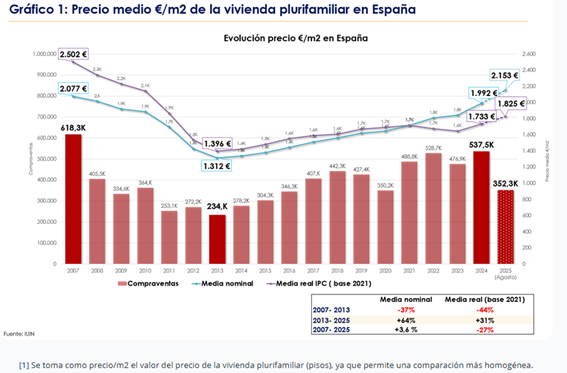
There is a perception that prices are skyrocketing, and the Notariat data confirms this, but with an important caveat. The truth is that, if we analyze multifamily housing prices from 2007 to the end of 2025, the price per square meter in Spain has increased by only 3.6%.
That is, nominally we are now at similar levels to 2007. However, if we adjust those prices for inflation (in real terms), housing today is 27% cheaper than in 2007. This "dual reality" explains why, although the price seems the same, the effort to acquire it is perceived so differently.
Since the famous real estate bubble crisis of 2007, there have been two very distinct stages in these 18 years (not forgetting the coronavirus crisis):
a first clearly recessive stage, from 2007 to 2013, where the price of housing fell 37%, the number of transactions was reduced by almost two-thirds, and the number of mortgages formalized fell around 80%, which showed the collapse of the real estate and mortgage market;
a second recovery stage, from 2014 to present, where the price of housing between 2013 and 2025 has increased 64%, as a result of the economic recovery we have experienced, population growth, and scarce supply. This 64% price increase contrasts with a 38% increase in net family income in the same period. Although on average there are different territories with larger fluctuations, such as the Madrid Community which has increased 103% and the Balearic Islands 113% compared to 33% in Catalonia.
In this graph you can see this evolution of prices per m2 considered in multifamily dwellings from 2007 to 2025
2. The three vectors of the current market
The Notariat report highlights three key points that are defining the market in 2026:
· Supply deficit and population growth: In certain regions, the lack of new inventory combined with demographic growth is driving prices upward, making it difficult for lower-income earners to access housing.
· The role of foreign buyers: The transparency of notarial data allows us to see how international demand continues to be a relevant driver in real estate transactions in Spain.
· The challenge for young people: They remain the group with the greatest difficulties. Solutions are being proposed such as ICO guarantees (to finance 100%) or the exemption of Property Transfer Tax (ITP) by autonomous communities.
3. Real estate purchases by foreigners
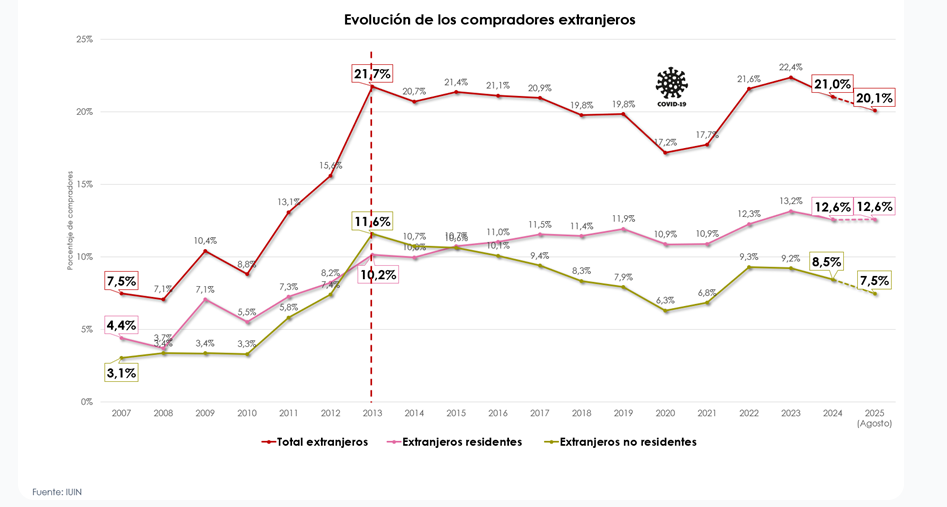
In the year 2007 purchases by foreigners accounted for 7.5%, that is, one out of every thirteen homes was bought by a foreigner, while currently it represents one out of every five homes. However, it is curious that the sharp increase skyrocketed until 2013 due to the real estate bubble crisis and since then has remained with minor fluctuations to date after overcoming the other major crisis, the coronavirus crisis.
Demagogically, this data is often carelessly thrown out by certain extremists claiming that foreigners are conquering Spain, but the truth is that most of these foreigners are residents in Spain. Additionally, foreign owner-sellers are currently at 11.5%, with non-residents being the majority.
Graph 2: Percentage of real estate transactions by resident and non-resident foreigners
4. Evolution of home purchases by young people (between 18 and 30 years old) comparing 2007 with the present
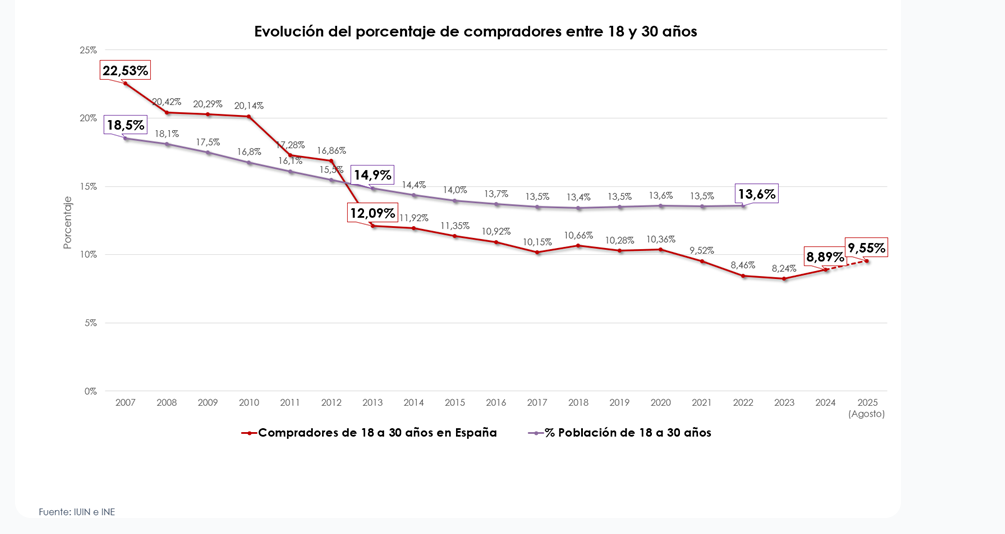
Here there is indeed a significant change. In 2007, young buyers accounted for 22.5%, a figure that has been declining, currently standing at around 9%.
Graph 3: Percentage of young buyers between 18 and 30 years old
5. The importance of authentic data
The great advantage we have today, unlike previous cycles, is transparency. Thanks to the Notariat Statistical Portal, we can access data with incredible detail, even down to the postal code level.
Having access to information based on actual deeds (not just listing prices from portals) allows both professionals and clients to make decisions much more aligned with the reality of the market. And this is marked by notaries but also by the College of Registrars through its MVI valuation tool.
Conclusion
The current x-ray shows us a market that has returned to 2007 nominal price levels, but in terms of real purchasing power remains below. As a real estate agent, my recommendation is clear: in a market with information asymmetry, data is your best ally.
If you want to know how these prices specifically affect your postal code or area of interest, I'll be delighted to help you analyze it!
Source: Data based on the article "The Notariate provides figures on Spain's main citizen concern: housing" (Notariate Statistical Portal, January 2026).