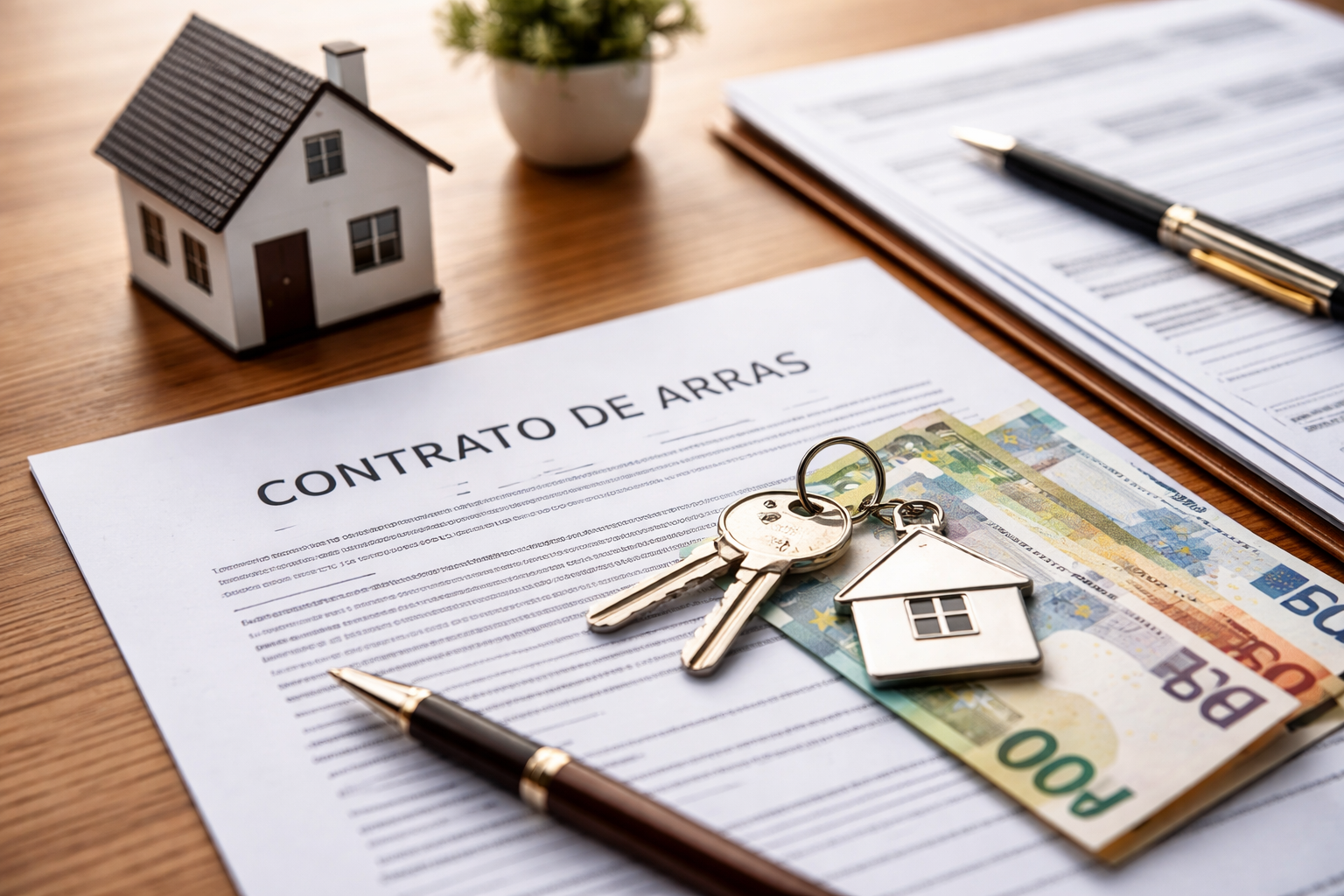
EVERYTHING ABOUT EARNEST MONEY
Earnest money in real estate transactions: a guarantee for buyers and owners
In any real estate transaction, there comes a crucial moment: when the buyer and owner decide to take the step and formalize the agreement before going to the notary. At that point, a figure very well known in the Spanish real estate market usually appears: earnest money.
Earnest money is set out in a document that serves to reserve a property and also provides security, clarity and commitment to both parties. That is why understanding how it works is fundamental whether you are thinking about buying or selling a property.
1. What is earnest money
Earnest money is a sum of money that the buyer gives to the owner as a sign of commitment to formalize the sale of a property.
This agreement is normally recorded in a earnest money contract, a private document in which both parties set the main conditions of the transaction: the price of the property, the deadline for signing the deed at the notary, the payment method and the consequences if any of the parties fails to comply with what was agreed.
Although it is not very common, earnest money can also be formalized before a notary and registered in the Property Registry.
In the Spanish real estate market, it is common for the amount delivered as earnest money to be approximately 10% of the property price, although a different amount can always be agreed.
For the buyer, it means that the property is reserved. For the owner, it means confirmation that the buyer has a real intention to acquire the property.
2. The importance of earnest money
The earnest money contract is one of the most important moments in the entire sales process. Not only does it formalize the agreement between the parties, but it also considerably reduces the uncertainty of the transaction.
For the seller, earnest money provides the peace of mind of knowing that the buyer has taken a firm step and made an economic commitment.
For the buyer, it represents the security that the property will not continue to be marketed or offered to other interested parties while the deed signature is being prepared.
In addition, the earnest money contract allows:
Establish a clear timeline until the notary signing.
Define the economic conditions of the transaction.
Provide for what happens if either party decides not to continue.
For this reason, having professional advice at this time is key, since a poorly drafted contract can generate problems or conflicts later on.
3. What types of earnest money exist in Spain
In Spanish law there are three types of earnest money, although in real estate practice not all are used with the same frequency.
Confirmatory earnest money
These are the simplest. They function as proof of the agreement reached and as an advance on the property price.
If either party breaches, the other can demand performance of the contract or its resolution with damages.
Penitential earnest money
These are the most commonly used in property sales in Spain. They allow either party to lawfully withdraw from the contract, but with a clear economic consequence.
If the buyer decides not to proceed, they lose the amount delivered.
If the owner decides not to sell, they must return double the earnest money received.
This system provides a balance between flexibility and commitment.
They must be expressly designated in the contract, with reference to Art. 1454 of the Civil Code that regulates it and with expression of its content
Penal earnest money
In this case, earnest money acts as a previously agreed penalty if either party breaches the contract.
They are not intended to freely withdraw from the transaction, but rather to strengthen compliance with the agreement.
Conclusion
Earnest money is much more than a simple economic signal: it is the moment when buyer and owner consolidate their agreement before the final signing.
That is why it is essential that the contract is well planned, adapted to each transaction and properly drafted, avoiding ambiguous interpretations or unnecessary risks.
In a real estate transaction, having professional advice from the beginning can make the difference between a smooth sale and a process full of complications.
If you are thinking about selling or buying a property and have questions about the earnest money contract or the sales process, I would be happy to help you analyze your case and guide you through each step of the transaction.